
It was an incredibly exciting moment for the company – our first time selling real products to real collectors. To everyone who placed a bid – both those who won and those who didn’t – thank you for helping us beta-test the platform. You have our gratitude. (If you haven’t already, please take a few moments to complete our feedback survey and help us improve the experience).
As friends and family, most of you are already familiar with the gospel of Blind Dutch Auctions; for a refresher, check out Section II of this zerocool post.
Here, we’ll just give you the headlines for this particular auction:
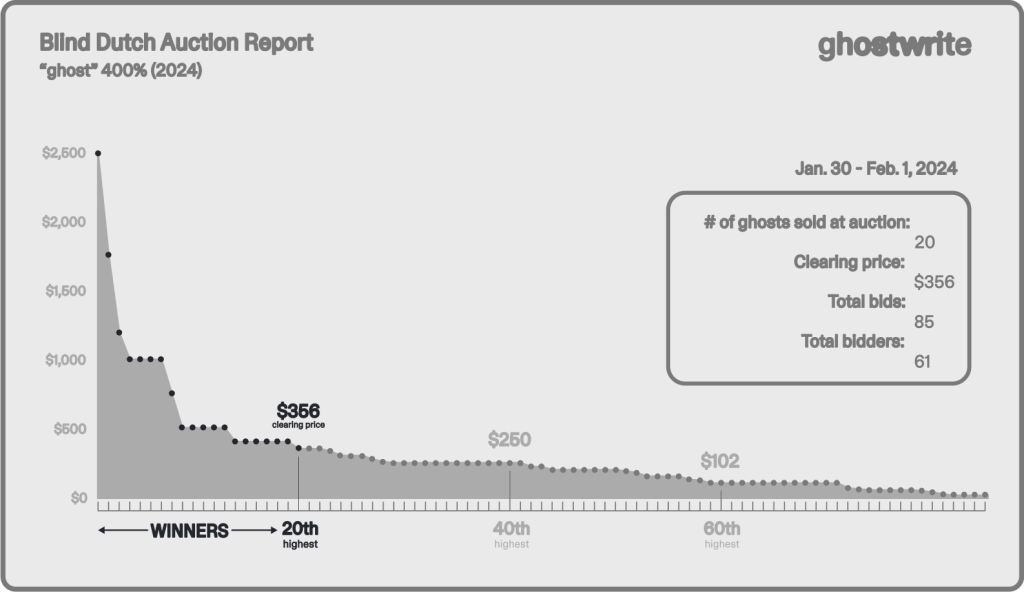
We invited around 200 friends and family to bid on 20 available ghosts. There were 85 total bids from 61 different bidders (several people placed multiple bids). The bids ranged from a high of $2501 to a low of $10. The 20th highest bid was for $356, which meant that the clearing price was $356, which meant that every winner paid $356.
Had this been a traditional release, it would have sold out almost immediately, as demand far exceeded supply. For this kind of product, it makes sense to let the market set the price. And because we used a Blind Dutch Auction, almost everyone paid less than what they bid.
This graphic shows the demand curve (e.g. the distribution of bids), along with a high-level auction summary:
For some of you, it may be surprising that the clearing price ($356) was this high. But this was a highly-limited release, in a space where many collectible toys from brands like KAWS and Bearbrick resell for thousands of dollars.
Moreover, we believe there’s a very good chance the market value will actually increase over time. As a brand, we want to make collectibles with real and enduring long-term value, and are committed to managing scarcity with that goal in mind. We can’t see the future, much less guarantee it. But we believe the value of this F&F ghost will only grow over time.

